Showing posts with label Farming Ladder. Show all posts

Monday, 20 June 2011

Messing About on Salisbury Plain ...


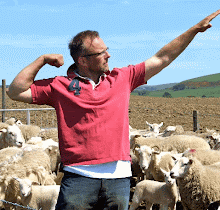
Its tricky writing about Tim White.  He is a follower of this blog, a great supporter and leaves rude comments whenever he feels aggrieved enough.  He is the closest thing to me I know on the farming ladder ... obsessed by sheep, has a love-hate relationship with Wiltshire Horns, seasonal lets only, started with little.  Just he’s a bit more professional and focused.  One of the driving forces behind Sheep Improved Genetics Ltd, he’s breeding wool shedding sheep in cooperation with other large sheep producers, recording everything, developing genetics, selling well.
I arrive just in time for music night in Maiden Bradley’s only pub.  People come from miles around to sing songs I’ve never heard.  Tim is on banjo and I’m on Guiness Extra Cold. Everyone is really good.  I once played the guitar and made people sing along on the understanding they had to pause for a while as I performed the tricky feet of changing chords. I don’t think I’d have fitted in playing the first verse of Leaving on a Jet Plane over a 15 minute period.
Over the next couple of days I see Tim’s sheep.  A lot of them are on Salisbury Plain.  Its poor stuff with no fences and a few tanks.  “Fields” all have to be electric fenced.  It strikes me the few first generation sheep farmers in this country might have good ideas and breed decent sheep but the system is such that we have to take the stuff no one else wants.  Tim has some good grass too but still has to be off it at short notice if the landlord needs use of it.  Enthusiasm and passion are his greatest tools.
Wool shedding hoggs with their lambs - I was jealous
There is an open day on wool shedding sheep that Tim is hosting.  EBLEX are involved and I am reminded that I wish they did Scotland too.  I talk to Liz Genever about grass.  She is behind the Grass Watch initiative and is developing really good information for sheep and beef producers, centering on rotational grazing.  I get so excited about it I start rubbing my thighs like Vic Reeves ... Liz retreats quite quickly at this point, but never turns her back.  I do manage to tell her about Cambodia ... everyone has to know - its compulsory.

"My lambs are this big at 8 weeks" Tim White converts more unbelievers

I leave Tim and his lovely family.  I wonder what the answer is.  A progressive shepherd with so much passion for his trade.  Where is the next rung for him?  I have seen a lot, observed a lot, written a lot ... but what advice can I offer Tim?  It comes as a shock to me that - after this long journey of discovery that with the report deadline just over a month away - I don’t have anything juicy to give him ... I don’t have the answer.  People like Tim deserve a break, an opportunity.  I squeeze into the camp hire car more sheepish than wolfish.  I still haven’t found what I’m looking for as I let go of the handbrake and head for Norfolk.

Wednesday, 13 April 2011

Zack Dingle Rides Again ...

A Multiple Choice Paper recently completed by Michael Blanche:
Qu. 1.  Both your cars die in the same week ... both will cost £2,000 each to fix ... you have less than that in the bank ... its 3 weeks before lambing and you have 750 sheep to shift off your old grazings.  Do you: 

a) Adapt
b) Innovate
c) Overcome
Answer - Adapt.  Buy a van for £700. Immediately acquire the nickname Zak Dingle from your neighbours.  Order a shiny red Hilux on contract hire which you probably can’t afford but as it takes 4 months to arrive the cool thing is you don’t have to think about it yet.

The Van ... hardcore!

Qu. 2.  You have purchased this “totally awesome” auto-drafter and have lots of stuff on a computer thingy relating to each sheep’s EID number.  If you don’t manage to link the ewe to her lambs, half the point of recording for genetic gain is lost.  You have always numbered your sheep before lambing with spray paint which by the time they lamb you can never read.  You get tired very easily and catching ewes, outside is beyond you.  Do you:

a) Adapt
b) Innovate
c) Overcome

Answer - Innovate.  Copy Lynton Arney - the nice man with the nice Border Leicesters from Oz - and make up neck tags using hi-viz tags and bungee cord that you can use next year too.  Be too concerned about choking sheep and make cord far too long. Go round picking most of tags up that fell off as soon as sheep stooped to graze.

If you look closely enough you might see a tag round its neck

Qu. 3.  You are desperate for grass and you get 180 acres of this:

Spot the ryegrass plant competition

Do you:

a) Adapt
b) Innovate
c) Overcome
Answer - I have no idea.  I’ll get back to you.

Friday, 1 April 2011

Pride Lost, Navel Found ....


London is exciting.  Mainly because, if I’m in it ... I am usually in it for a reason ... on purpose ... and not by mistake or due to taking a wrong turn. 
This time it was The Farming Ladder conference.  Organised by Sir Don Curry and Dennis Chamberlain. It had the same title as my Nuffield study and meant I felt obliged to go.
I think this sort of conference helps and there were some really good speakers.  This said, I came away feeling a bit empty.  A previous scholar told me at a get-together last year to “be selfish” in my study ... I’d get far more out of it.  I didn’t want to do that.  I wanted to help and come up with suggestions and potential answers.  Now I realise that there are plenty of suggestions, lots of ideas and a good number of potential answers ... its just that very few of them will actually make it all the way to practical policy. Taxation changes are sorely needed. Agricultural Holdings legislation could do with being reformed or even repealed ... with more imaginative options introduced.  The subsidy system protects the established and punishes the new.
Yet the conference convinced me that the only person in the room that was going to help me ... was me. The historic battle between landlord and tenant rumbles on, each taking a stance the other can’t accept.  George Dunn from the TFA was really impressive, a very clear thinker and excellent communicator.  I wish he was on my side ... but he’s not. He started off by saying it was vital that the calibre of entrants into farming had to be high .... hear, hear!  Then he proceeded to put forward the assertion that succession tenancies - where the only test of your calibre is who your father was - were the BEST farming ladder ... were THE farming ladder.  

Succession is the key to the farming ladder! [cue sigh of exasperation] .... And so the land constipation of this country will continue to cause discomfort.
Trying to draw parallels with diarrhoea prevention and interventionist legislation ... probably stretching it

If the tenants were the Imodium with a high level of intervention in the letting process ... the landlords seemed to take the more prune juice approach of the free market. Freedom of contract rules OK!  I sympathise with this attitude far more.  Yet it dramatically depends on trust. Trust hasn’t been prolifically used in this ancient struggle. Also, and crucially, freedom of contract tends to put off the issue of investment to another day ... ad infinitum.  When tax incentives were discussed and it was suggested that certain loop holes be closed ... some landlords got a bit edgy. “Lets have a system that suits us” was the message my cynical ears heard. 
Essentially, it was a conference where vested interests were vocalised ... albeit lined with good intentions.  It is useful to talk and outline your position ... jaw jaw rather than war war, and all that. 
What struck me, though, was that before legislation ... before policy ... attitudes need to change ... paradoxical cultures need to develop and recede.  The conference was helpful in chipping away at this.  But as we talk, we are also part of a huge orchestra of fiddles ... we play intently ... as Rome burns.  The bastions of the past will be the bastions of the future.  UK agriculture ... its quality ... its merit ... its pride is being suffocated by short term views, short term greed and an inability to see beyond our own, very personal, navels. 


Nero "fiddling" while Rome burnt ... I always thought it was a violin
Going round the world - where no one looks to the UK for agricultural guidance - is a humbling process.  No one rates us!  This is the country of Townsend and Bakewell ... this is the country that was the stud farm to the world ... this is the country that invented the tractor, the plough and the threshing machine.  We have been distracted by chasing subsidy ... where a meeting on a new support scheme attracts an audience of 200, whilst a technical seminar gets an audience of 10.  We are disabled by our historic struggle for the control of land. We now think in individualistic terms ... our farm business ... our land owning business.  We only think of "our industry" when it comes to supporting it with payments with other peoples money.  All the lobbying ... all the talk ... is to do with subsidy, intervention and regulation.  We don’t seem to have a communal pride in our real industry anymore and we no longer judge it on production or on innovation.
Bakewell ... in my Top 20 Hero List
A perfect storm is brewing.  Food is going to be a big issue in 2030 ... and big business.  In the UK we'll probably still be talking at conferences, fearful someone else might benefit slightly more than us ... whilst the rest of the world have left us behind. We were once a world leader in production, we had an industry to be proud of in a worldwide context.  Unless we think ... and, more importantly, act ... to free land up, to make an industry that is merit based, where the best farmers farm - whoever their father was ... we will never have that pride again.

Wednesday, 30 March 2011

Like a Virgin ...


“My name’s Michael, thanks for coming .... you know you guys will always be special to me [cue slight unease in small group of complete strangers, straight off a mini bus from Aberdeenshire] .... I was a farm visit virgin ... and I’ve lost my virginity to you ... [cue unintentional but creepy smile from Michael].”

Some things sound a lot better in your head before departing from your brain, stopping briefly at your vocal cords then finding their final destination in a vast lonely expanse of open air and in the tangible discomfort of fellow human beings.
It was the first time I had a group come and see the sheep though.  I spent most of the time saying they weren't very good, even though I think they are.  I talked for over an hour about the sheep, how I started, what I do, what I feel and about the people I met during my Nuffield trips.  The Nuffield part of it might have been forty minutes of blether but it had to summarise eight and a half weeks of travel.  It focuses your mind on what the main issues have been.  Obviously, I admitted in front of grown men (and women) that I almost cried speaking to other grown men (and women) about Cambodia.  I then proceeded to get a bit emotional about it all over again.  That country gets me going every time.
No one fell asleep this time. Largely because they all had to stand ... in the cold ... 
Notes to Self: 
  1. Pursue mild forms of enforced discomfort on any future audiences to prevent them snoring
  2. Man up re. Cambodia, for goodness sake!!

Sunday, 13 March 2011

Dying is Easy, Public Speaking is Hard ...


Despite what the most recent blog posts suggest, I’ve been back in the country for a month ... I’m just really slow at constructing sentences and thinking about words containing more than four letters.  My brain speed seems to be constantly in first in the low ratio gearbox (or whatever that smaller stick next to the bigger stick in my pickup is called).
Imagine then, my discomfort when I had to speak at a Scottish Enterprise Rural Networking Event in Ayr on Tuesday.  Talking out loud has never been a strength of mine.  Putting a lot of words together in the right order over a 30 minute period is hard ... and harder still when 24 people are looking at me with total bewilderment in their eyes and 1 is fast asleep.  Talking in public requires a fast and sharp brain ... no luck there then.
I got a few laughs but not nearly as many as I'd hoped ... I should have brought a snare drum and symbol to communicate what I just said was intended to be amusing.
Embarrassing highlights included: reading out lyrics from a Mylie Cyrus song (the bewilderment factor was raised at least three notches during that error of judgement) and almost crying when I talked about Cambodia ... voice quiver ... dramatic pause ... it was really close.  I talked about emotion a lot, and bared my soul a little ... to the point I expect most of the audience were uncomfortable and thinking I should really go and see Dr Bonkers (the famed Psycho-analyst).
That said there were some things I said that had potential.  It focused me.  Oddly I appreciated so much more of what I had learnt in India and Cambodia during the process of speaking in Ayr.  If I came back from those countries with one word it would be “Innovation” ... although this is neck and neck with “Perspective” and “Sorry”.
I still need a lot of practice in speaking out loud though .... a LOT of practice.

Friday, 4 March 2011

[in the style of the Batman theme] da na na na na na na na - Hat Man! ...


In my last post I briefly mentioned a chance meeting with an elderly man who wore a hat ... on a plane ... who sang songs in public.  I also mentioned that the Raipur leg was my nominal contribution to the organisation of the trip.  The first day went well ... largely because Ricky Thaper organised it ... not me.  
Day 2 proves more of a challenge.  There is nothing arranged. In desperation to please my restless colleagues, I phone Hat Man on Day 1.  He is in “a meeting” and says he’ll phone me back ... he doesn’t ... I berate myself for thinking he might.  Next day ... a lie in, a relaxed breakfast, we get to 11.30 and no one has complained directly about doing nothing but there is an undeniable air of frustration.  We try to take a rickshaw to a Walmart to see what an Indian supermarket looks like.  The non-English speaking rickshaw driver reckons I must have meant the centre of town and takes a punt, leaving us lost in a busy street ... nowhere near a Walmart.  
Just as all hope of not wandering around aimlessly is at an end ... Hat-Man phones.  He has been to our hotel with his brother - head of the agricultural department of Chattisgarh.  His brother has had to leave for a “meeting” but we head for his office. Raipur is a big city ... we are the only westerners ... as we start the goose chase, people stare, smile and wave.  We enjoy our adventure ... at least, I do.  I smile and wave and even do the “thumbs up” more than is technically cool, as we walk.  
After asking at least five times for directions we get to the office.  Hat Man is actually called Mr Poorit and he is high up in a renewable energy company (Tony likes renewables so he is pleased).  Mr Poorit is a character.  A former colonel in the Indian army, a veteran of three wars he possesses a personal wisdom that comes from a very full life.  I love old men like Mr Poorit. He is excentric, mischievous and warm ... what I want to be when I’m old. I feel we click and have an odd bromance for 20 whole minutes.

Tony, me and Mr Poorit ... in the final of the "Funniest Face" competition.
Above Tony's head there is a picture.  It says "... for everything you gain; you lose something else; it is about your outlook towards it; you can either regret ... or rejoice".  Deep! 

He tells us that Indians are misers, they are real business men and ... in a Borat type moment - they are “like the Jew”.  Britishers are nice but they are not financially as bright as Indians.  Mahatma Gandhi was a good guy but his policy of non-violence was wrong. If someone hits you, you hit them back harder.  I loved it ... not because I agreed with everything but just because his opinions were definite and devoid of malice (though I suppose hitting people isn't that nice).
We finish by singing a Doris Day song in the middle of a busy office... “Que Sera, Sera, ...Whatever will be, will be ... The future's not ours, to see ... Que Sera, Sera ...”  Given my midlife crisis and my palm reading that shows I have no life line from now on ... I consider this appropriate.  We shake hands, knowing we got on well, but knowing we will never see each other again.  I am emotional about our farewell, which I wasn’t expecting.  Goodbye Mr Poorit ... the honour was all mine.

Friday, 25 February 2011

Intensive Care ....


Delhi airport.  Its Thursday.
We have said goodbye to James. We cry longingly on each others shoulders and seek professional advice for our combined loss.  Obviously I am using sarcasm to cover up the fact that this is almost true.
After taking all the responsibility for so long as group leader, organiser and Michael Blanche’s chief carer, Tony gets a well earned rest.  He has been immense.  We had a tipsy chat in November. I said I was going to Cambodia and India. He said he’d like to come ... thereafter he organised almost everything.  If it wasn’t for him I think I’d still be at Phnom Penh airport trying to work out how the electronic doors worked.
This was the part of the trip I “organised”.  This basically involved asking Ricky Thaper (treasurer and spokesman for the Poultry Federation of India) to organise things for me.  We meet Ricky ... he laughs at my jokes ... what a great guy!! 
We fly to Raipur, capital of the state of Chattisgarh.  I sit next to an elderly man with a hat.  He sings a lot. I join in when I can.  He insists we contact him during our visit.  I am not sure if this is a terrorist trap.
The next day we visit the ABIS group.  Owned by Mr Bahadur Ali, the business had 10,000 broiler chickens in 1985.  Now it turns over 2.5 million birds per cycle and there are 7 cycles per year.  It has quarter of a million breeding birds.  He has a 2,500 dairy cow herd and 1,500 buffalo. He has a huge feed mill. He produces pet food, fish feed and 5,000 tonnes of solvent.  The milk is packed and sold under his own label.  30 veterinarians work in the business ... everyone we meet is called “doctor”. The business has a 2,500 labour force.
The Group with one of the many Doctors and Ricky in the foreground
I’d seen vertical integration before but this seemed to also include horizontal, backwards, forwards and sideways integration too.  You sensed there were no barriers in ambition or, indeed, implementation.  There was no fear in growing the business.  It was like going to visit the aftermath of a huge business explosion.
At the end of our day we meet the main man - Mr Bahadur Ali - he walks in and there is an aura about him.  He is more comfortable speaking his native tongue ... which adds to the mystery.  His questions are incisive and very focused.  Weirdly, his questions are kind of answers in themselves as they seem to reveal what the important issues are on a particular subject.
He explains how he took his business from a humble beginning to one of the biggest agri-businesses in India.  From 1985 to 1996 he built the business’s effectiveness.  But growth was relatively slow. 1996 saw him attend the International Poultry Congress and that event seems to have transformed his whole business. His vision was radicalised ... to drive for scale and vertical integration.  Thereafter, the growth graph was close to being as vertical as his integration.  It rang a bell ... this was the graph a share milker in New Zealand drew me on the back of an envelope ... it was the graph a Kiwi equity partner now worth millions of dollars showed me on his computer ... the graph of an effective first generation business.  Frustratingly slow growth then .... ker-bam (if that is a word) ... a steep line upwards thereafter.
The ABIS group operate - as far as I could work out - on just over 100 acres.  I’ve seen intensive agricultural businesses before but this was another level.  I know its not quite a true benchmark figure - they rely on other farmers for a lot of raw material and some of the enterprises are beyond agriculture - but the business’s Output ... my calculator tells me ... is over £1.5 million per acre!

The wonder of labour - everytime a calf defecated there was someone on hand to clear it up
Mr Ali asks us about the potential for a serious sheep business in India.  I suddenly get a dose of verbal Delhi belly ... my words come straight from my head through my mouth without touching the sides.  I thought it would be a great idea ... introduce better genetics ... get hold of lots of land ... rely on scale ... on and on I went ... it was becoming interminable.  Mr Bahadar Ali asked what stocking rates we had in the UK for sheep.  4 ewes to the acre on decent permanent pasture, up to 7 on good stuff, I said ... I was unstoppable ... I thought he would be impressed.  The colleagues from ABIS looked at each other, paused and then laughed for a long time ... 4 ewes per acre versus £1.5 million turnover per acre.  
Being laughed at made me think.  Land in Chattisgarh would be worth around £30,000 per acre.  We don’t have values like that ... yet.  However, if the land price in the UK continues on its crazy path ... I’ll probably live to see the day they are.  We will still only have land that supports 4 ewes to the acre.  Maybe the Indians were right ... it is comical.  Intensification and integration are a lot more serious. They can feed the world. Taking this theory to its logical conclusion, maybe the sheep industry has no future on any land that can be used for any other conceivable purpose.  Its a cheap land enterprise and cheap land may never be again. Maybe the entire UK sheep industry will be forced to retreat to the hills ... spending the rest of its days with its begging bowl held high.

Thursday, 17 February 2011

Carry On Up the Punjab ....


Somewhere near Chandigarh, Punjab, India.  Its Saturday. The group now numbers five ... we’re not exactly famous but at least three of us have had lashings and lashings of ginger beer the night before.


We take a walk through Chandigarh centre to experience the shabby madness that seems to be standard in India’s urban centres. James gets his shoes polished.  I do too. James pays his polisher the equivalent of 20 times the normal rate .... everyone gets very excited ... a rather large and amused crowd has now gathered ... its all I can do to convince my man 7.5 times the correct rate is acceptable. I power walk ... hips wiggling vigourously ... away from the problem.

The initiation of the shoe shine incident ... before the crowd gathered

We are picked up by the sophisticated Kanwal.  Tony - our glorious leader - had found his farm stay on the internet. It turns out its like some sort of cyber gold rush ... the guy is brilliant.  We visit two dairy farms, inspect wheat and vegetables.  The Punjab is India’s Japati basket. 44% of the grains (rice and wheat) produced in India are produced here ... on 2 % of the country’s farm land.  Bare agricultural land values range from £30,000 to £60,000 per acre ... hope value (for future development) has a massive impact that drives up price even further.  The Green Belt around Chandigarh can command up to $500 million for 1 acre. 
Land in Punjab was subject to severe legislation after independance.  The maximum holding any individual could own was set at 25 acres. This together with subsequent splits via inheritance means farms are small (90% of farms in all of India are 5 acres or less) ... yet 3 crops of maize a year is easy in Punjab, one guy reckoned 4 was possible.  The first dairy farmer we meet tells how his grandfather dug a well in 1947 and only needed to go to 10 feet; his father then dug a well in 1962 and had to go deeper - 62 feet; then he himself had to dig a well in 2010 ... to get to water he had to bore to 500 feet.  Such is the challenge in the Punjab ... what the weather giveth, the weather (and extreme irrigation) now taketh away.  The significant move to dairy ... away from thirsty rice ... is a reaction to this challenge.
We meet the head of the village and all his family ... he has a big family.  We drink sugar lightly diluted with warm buffalo milk. We drink tap water.  We are an attraction. A child comes in and as if in awe of a deity,  swiftly kneels to touch Rona’s sandals then quickly departs.


The village leader and his family ... just after we'd drank tap water

We return to Kanwal’s house and meet his father.  He is a serene Sikh gentleman with a warm sense of humour.  We learn much just talking to the father and son team.  From their reading of my palm, I learn that I have had a midlife crisis and the future is not foretold ... I consider this does not represent new information. I then worry that there is no life after the mid life crisis thing and keep looking at my palm in case the line has formed yet.  They both get very excited by James’s hand, its so unusual I think they might wet themselves in some sort of synchronised urination display.  He is nicknamed golden hands for at least ten minutes.
We giggle on and off for another 24 hours ... we have deep debates ... we learn many new things about India and each other ... until on our last night we up the giggle intensity ... I giggle like I haven’t giggled for a long, long time.  My stomach hurts as I go to bed - its a happy hurt ... though it still could be the tap water. 

Wednesday, 16 February 2011

The Dogs That Bark at Elephants ....


Its not so much politics in Cambodia but rather power. Corruption is systemic and blatant ... so blatant there’s almost an honesty to it.  Some said that at least it was obvious rather than in the western world where its duplicitous and subtle. Another theory I got was if there were a change of government there would be even more because those in power now are already very wealthy.  Anyone new would have to build up wealth through yet more corruption.  
There is a stability provided by the current administration, but sights like the many brand new Range Rovers driving through Phnom Penh, suggest there are hundreds wealthy as well as millions poor.  This wealth is almost certainly not gleaned from moral business practice, built on compassion for their fellow man.  A bloke down the pub (always the best sources) told me half the aid coming into the country is “lost” but could probably be found again in the shape of the flash cars driving around its capital city. These drivers scare me.  They feel untouchable.  One person explained that there is a saying that the people are dogs and the ruling class, elephants.  Dogs might be able to bark at elephants but little else.  Elephants are untouchable, undefeatable, unstoppable. Thoughts of political improvement for its population are burdened by a hopelessness that seems so absolute and so conspicuous.
You consider temporarily that maybe its not so bad ... in the west we seem so self righteous that our way is the best way ... maybe democracy is over-rated ... maybe there is freedom in an absence of regulation.  Then you realise that there is no protection of people.  There are few rights.  The Economic Land Concessions in Cambodia that recently hit the headlines where 1 million hectares of land has been taken over by corporate firms is an example.  Many who “own” land, don’t.  The legal rights for land ownership are blurred in most instances.  It seems the small farmer in these cases get money for their farms but it is a surreal compulsory purchase - money or AK-47 - that’s the choice.
Economic Land Concessions represent the sound of ideologies clashing.  Cambodia can’t move on agriculturally without efficiencies in scale and technical expertise .... corporate farming is a quick fix ... the capitalist answer.  But individual people should have rights to what they have ... they should be respected and cherished not bullied and stolen from ... profit of the few can’t in anyway excuse the immediate suffering of the many.  There is a sadness and an intense injustice to it all. 
In a land where over 70% of the population have an income of $2 a day or less whilst the ruling class drive around in £75,000 lumps of metal, concealed by blacked out windows ... you start thinking there must be a better alternative species to belong to than human beings. 

Saturday, 12 February 2011

Love You Long Time ...


Bay of Bengal (get to India, turn right and its the first sea on the left (... and right)), 35,000 feet up.  Its Friday.

We left Cambodia yesterday (travelling by bus through Thailand to Bangkok).  As usual I am confused. I loved the country and its people.  If I stop and think, I wonder whether it touched me more than I normally allow myself to be touched by land and strangers (that sounds a bit wrong, doesn’t it?)

I talked to a good number of locals about their past and their future; about their issues and their views.  Its easy for a daft Scotsman with spectacles to make skewed judgements based on minimal research ... but I always try and take the easy option. 

The agriculture is so labour intensive, its scary.  Most will work from dusk till dawn in a body position that homosapiens are really only designed to be in for short periods.  Time and effort are cheap here. There is so little money in it, success isn’t judged on profit or loss but malnutrition or health. The marvels of mechanisation ... of innovation ... of the power of the mind rather than simply the hands ... fall into a wondrous clarity in Cambodia. The examples are less complex, less forgotten and thus more compelling than in the UK.


You realise that breakthroughs in production methods are led by individuals for private gain ... yet whole communities and countries and continents benefit.  Innovation grows from need ... desperation even.  Innovation comes mostly from those with a contrasting rather than corresponding story to the traditional farming system. Innovation is a dish best served by the disadvantaged.  

We travelled through Thailand yesterday in 30 degrees of heat and you sensed a coldness compared to Cambodia.  There were far less smiles, a scarcity of laughter that I had become used to from the Khmer people.  You realise how vital smiles and jokes are in communication when normal communication is difficult.  I felt safe in Cambodia.  Phnom Penh wasn’t intimidating and I’ve felt a lot more threatened in Edinburgh.  British people seem angry compared to Cambodians, yet in comparison we don’t have much to be angry about. 


Despite being effectively a dictatorship ... it feels more free ... there is a refreshing lack of regulation and restriction.  Driving for example consists of buying a car, getting a family member to show you how to drive for a couple of hours, then off you go. You can get a licence but this seems optional. You drive on the right though this is definitely optional.  The spatial awareness of how your bumper might interact with another moving object feels like it comes from a special gene in Khmers that has been highly developed under the strict principles of Darwinism.  Back home (and even whilst away) I have just been through a prime example (SRDP grant applications) of how well meaning rules can become ever decreasing circles of restriction as they multiply and dig a deeper and deeper hole until you strike pettiness and stupidity (not that I’m sore about it, you understand).

Back in the UK we feel empowered ... in Cambodia they feel powerless.  Our public’s opinion carries weight in the minds of our political leaders ... in Cambodia those in power treat their people lightly.  Yet we are bound by regulation, rules and tied tight by bureaucracy.  In Cambodia a public with no voice and no money still have a strange freedom about them.

Goodbye Cambodia, even though we might never meet again ... I will always be your friend.

Thursday, 3 February 2011

Extreme First Generation Farming, Dude ...


Koh Kong, Cambodia, 10 miles from Thai border.  Wednesday.

We meet a Khmer man called Paddy ... not certain this is his real name! He runs a bar, has a tuk tuk, smiles alot and is a cool dude.  He takes us to the river.  We meet Noy.  Noy is one more notch up on the cool dude numeric scale compared to Paddy ... which is saying something.

Noy speaks excellent English.  He takes us to a tiny village 30 minutes up river.  Each family has their farm of between 1 to 5 hectares. They grow melons, lemongrass, sugarcane, sandalwood and funny looking fruit that I don’t recognise.

The people live on very little here but the entrepreneurs amongst them harvest and sell their excess produce in Koh Kong market.  

There is one in particular who - having been prosecuted for growing marijuana elsewhere (!!) - moved into the village to start again.  He tried doing different things (crops, irrigation methods, fertiliser etc.). Some things were successful.  The other villagers started copying him.  Here was the innovator and driver of wealth creation not just for himself but indirectly a whole community .... I reflect that this might be the closest person to a new entrant I’ll come across in Cambodia.

We stop at a rickety bamboo bridge and we direct another question to Noy ... He answers ... These moments are special and sweet ... We realise he is a first generation farmer ... More questions follow and we realise he is an innovator ... We realise he has an education, an immense knowledge and a mind with its gates wide open. He told us that when he decided to farm, he came to a village ... asked about land ... and was pointed in a direction and told “help yourself”. I am so excited I consider wetting myself.


The Dude, Rona and me ... just before I wet myself
As we continue I also realise this is probably the most extreme first generation farmer I have met. You see, Noy was born in a refugee camp over the Thai border and stayed there until he was 12.  His English is excellent because the UN taught him the language in the camp. He doesn’t know what day he was born as everyone was disorientated as they fled from Cambodia. He never has a birthday.

The camp was hell. Thai soldiers guarded its perimeter with guns and unsmiling stares. No one was allowed to leave. Largely, made up of women and children, if a female strayed too far from the main group they were likely to be raped by the guards.  Food was something that was always given .... never found, harvested, purchased or sold.

I asked him why he wanted to farm ... his quick and definite response was a single word that came from a deep, deep place .... “Freedom”. 

Wednesday, 2 February 2011

How's Your Rice? ....


Kampong Chhnang, Two hours north of Phnom Penh.  Sunday.

We have started to get a little more insight into what issues are affecting the lives of modern day Cambodians. Malcolm - Tony’s cousin who’s lived here for 6 years - has been brilliant.  We have been so lucky to have his knowledge of the country.

We are staying in a farm-stay here. At one point I thought I was going to have to share a bed with Tony ... Tony thought he was going to share a bed with me ... we were both nervous.  In the end Tony blinked first and I was able to act as a lone MacDonalds Drive Thru for most of the mosquitos in the area.

We walked for about three hours through the paddy fields and the lotus.  We met farmers.  They spoke a different language and have a subsistence existence but they still reminded me of speaking to farmers in the UK.  Mostly laid back, liked a joke and a news.  The normal greeting is an almost singing, saying “How’s your rice?”.  Which reminded me of a  Scottish saying - “Foo’s yer Coos?”


The fields were mostly only appropriate for dry season rice.  The Meekon (which is miles away) overflows in the wet season (June to September ... its getting shorter) and the paddys we were walking sometimes were flooded with 5 metres of water.  Margins for a hectare (the average size of farm we were seeing) are poor and after a family is fed there isn’t a lot of cash coming in.  Loans are usually taken and when all crop is sold and the debt paid ... they are back at square one. Its the one slender thing, amidst the poverty and extremely basic living, I felt I had in common with them!

Dry season rice needs water pumped into the paddy fields; wet season crop relies on the natural rains ... the “working with nature” option is more profitable.  The farming craze in the area is Lotus.  Its leaves and petals can be eaten, its seed head used for decoration ... but my ignorance reckons this is a niche crop with limited life expectancy ... its definitely not rice.  They have to pump water into these fields 24 hours a day but expect a slightly better end price.


In the evening we had a 64 old lady farmer come and speak to us. She radiated an unstated wisdom but looked 94. She’d spent most of her waking life bent over in a paddy field.  It was a special hour listening to her.

Farming in Cambodia is hard beyond what I can fully appreciate.  The lack of mechanisation makes you realise how our own hands are not enough to progress.  The ingenuity, innovation and thought of those special people in the UK’s farming past ... the inventors, the early adopters, the thinkers ... the forces that have got us to where our industry is today ... should be worshiped on a daily basis. 

Tuesday, 1 February 2011

Hell Frozen Over ...


Tuol Sleng Prison ... codename: S-21 ... Phnom Penh. It’s Saturday morning.

Tuol Sleng was a tranquil school, a hub of education, that was converted to become hell on earth in 1975. The Pol Pot regime tortured and killed all those they took there (approximately 20,000). Only seven people got out alive.

I don’t think I’ve been to a more powerful place. We see photographs of the room we are standing in ... everything is the same except for the dead body in the photograph ... throat slit, fingers cut off. The photographs were taken by the Vietnamese immediately after storming the building in 1979. Other faces stare at me from the black and white ... faces that had to suffer like no one should, before they met their end.


The lady that shows us round explains how she lost her father, a brother and a sister to Pol Pot. How Phnom Penh was evacuated in 1975 and she, as a six year old, walked for two weeks to find safety. She explains that the torturers were largely children. They were brutalised and brainwashed in jungle camps before being sent to do evil upon their fellow people.

We walk the busy streets of a city once deserted ... and people smile ... we travel by tuk tuk ... and people wave. I realise all these people will have fathers, mothers, sisters, brothers, cousins or grandparents that died during the regime and the famine afterwards. 2 million died, 1 million fled the country ... out of a 7 million population. That’s the equivalent of 17 million dying in the UK today; and over 8 Million fleeing as refugees. But the smiles and waves have so much more meaning ... displaced people can still find a place for gentleness ... horror and sadness can be overcome ... me moaning about the lack of rungs on the farming ladder feels incredibly pathetic.

Monday, 31 January 2011

Too Cool for School ...


24 hours. 5 minutes sleep. 6,000 miles. We are in Phnom Penh. Straight off the plane. A tuk tuk ride - sything through the heat, smells and madness of an alien culture - to the Royal Agricultural University to meet the Rector ... the main man.

With excellent English and endless patience for daft questions he draws the skeleton of Cambodian agriculture so we might be able to add bits of flesh at a later date.


He spoke of the future mostly. The one time he dwelt on the past he became emotional. By 2015 Cambodia wants to be the third largest exporter of rice in the world. The target is 1 million tonnes exported. In 2011 they officially export nothing.  Already though, in the last 10 years, they have increased their average yield from 0.9 tonnes per hectare to 2.7 tonnes.  New varieties, irrigation, double cropping have all helped.

Before Pol Pot - in 1974 - 85% of the population were farmers.  Now it stands at 74%. 2 Hectares of Rice paddy makes a decent living especially if it can be double cropped. Yet most have around 1 hectare, many can’t double crop.  

Corporate agriculture is now gaining momentum. As there is no legally effective deeds of ownership, companies have started farming smaller farmers’ land.

The land price has increased from $1,000 per hectare in the recent past to $15,000.

But the one question I wanted a different answer than I got was in relation to New Entrants.  The brutal facts are 1. No one aspires to farm (too hard and looked down on) and 2. Most of the population have a direct family link to a farm anyway.  As my study is on aspirational new entrants from non-farming backgrounds, I briefly consider my stupidity for not thinking the trip through ... I should really go back to the airport ... but then cold beer amidst the craziness of Phnom Penh with two fine Welsh gentlemen was too hard to resist.   

Monday, 24 January 2011

Operation Futile - Phase 2 (Shock & Awe) ...

Zero nine thirty hours, 19th of January, I perform a flanking maneuver and reach the village post box, encountering little resistance.  My breath is shortened by adrenalin (.... or smoking).  This has to work .... The first advance of Operation Futile - (ok ... that only means writing an article in the local paper) - has proven unsuccessful. Now with limited numbers (that just means me), many casualties (largely in the pride and ego regiments) and basic rations (no beer until I get to Cambodia) I have initiated my second assault. The mission: to secure land for my people (/sheep) and thus live an endless peace. 
I deploy many copies of a two page flyer into the post box.  These are to a number of Estates controlling a total of 275,000 acres; more flyers are addressed to all the Land Agents in the area - probably controlling a similar amount of acres.  That’s half a million acres ... and I only want 200.
I wrote the flyer in my own slightly jokey, slightly informal, slightly “special” style.  I know some people find this way of writing a bit weird and I’m guessing that that particular demographic might be highly represented in the world of land agents.    
I’ve had two responses though - one to offer sympathy, but he hadn’t let anything for 5 years and is unlikely to ... if things don’t change significantly.  The other was more promising - potentially a joint sheep venture on the nearest Estate to home. I’ve been to see him already and managed to speak, putting most of my words together in the right order.  I actually sold myself - which is unusual - and painted a picture of my sheep, breeding strategy and ambitions with a broad brush, using bright colours.  I can do no more now but hope. 
The other conversation I had was interesting too. A thoroughly decent chap who ran a big Estate.  He was totally cheesed off with the whole tenancy thing and his total distrust of politicians.  This mainly stems from the huge issue discussed earlier this decade in Scotland of allowing tenant’s to have an absolute right to buy their own farms.  He didn’t quite say “those commies in Holyrood” but it was evident he accepted MSP’s had absolutely no sympathy with his challenges in trying to protect his employers assets and glean any sort of income. 
In many ways it’s a class war out there - landlords versus tenants.  Each ensconced in their trenches, whilst farming is not allowed to grow on the battlefield due to their impasse.  I’d like to see the day when both sides agree to play metaphorical football in No Man’s Land, give each other a big hug and then busy themselves with something worthwhile like filling the trenches in.  Birds will sing, as the poppies sway in the breeze, bathing in the bright warmth of evening sunlight.  They will skip hand in hand through the fields, down the gentle hillside, toward the quaint Midsomer-like village of Cloudland-apon-Cuckoo.


Tenuous music video usage

PS Its to Heathrow on Wednesday then Cambodia on Thursday and then on to India on the 4th.  This will be my last trip abroad for Nuffield .... probably.  So then its a case of a slow surrender in accepting some special things can’t carry on forever.

Saturday, 15 January 2011

Farmers 4 Justice ....

Only 15 days in and I’ve packed a lot into 2011 ... I’ve given up smoking three times already.    
I have used the ‘F (sweary) word’ - as a noun, verb, adjective and prefix - a total of 328 times.  Principally its usage related to EID tags and getting them into sheeps‘ ears ... its harder than you think ... if you are a bit useless.  I huffed and I puffed and now two thirds of the flock are done.  Some currently have 5 tags in their ears which - deep in the dark recesses of my mind - I think is illegal, punishable by continued tutting and a resultant long term sense of worthlessness.
I also had that weak stab at the resourcefulness I mentioned in the last post.  Its 75 days and counting before I need to be off my current grazing.  I have nothing secured for the summer (just writing this makes me feel slightly queazy).  So, I wrote a press release and sent it to my friendly local farming editor from my friendly local paper.   It has a circulation of 80,000 and a good farming section.  Alot of people read it and hence if you appear in it, the teasing is relentless.

Article so big, A4 size just wasn't enough!!
Not my best side ....

Obviously I’ve had no success.  There was a very nice lady that phoned up to say she wouldn’t like to see me stuck and has 100 acres. It’s even further away.  I worked out that by March this year - having had the grazings 35 miles away for 5 years - I will have travelled the equivalent of twice the circumference of the Earth just to get to the same point where established farmer’s walk out their house door!  .... I have the carbon footprint from the really rough area of hell.  The nice lady was nice enough to say she’d keep the offer on hold just in case I can substantially aid Kyoto Protocol emission targets and find something closer.

One of my friends - he just thinks he’s a client - said I had shot myself in the foot by saying, at the end of the piece, that if I don’t make it up the “Ladder” it would have been down to me and no one else.  He reckoned I had a duty to complain about what is obviously a failing system.

Now I’m feeling guilty.  I’ve also started thinking that perhaps if publicity and phase two of my plan - to be confessed in time - doesn’t work ... maybe it isn’t me after all ... maybe there is nothing available.  Phase three will have to be dressing up as Batman and shouting from the roof of the Parliament building at Holyrood ... either that or actually phoning people ... I’d prefer the former - I’m no good on the phone and like how I look in a Batman outfit.


I just feel there has to be opportunities out there ... people thinking about letting ground out ... but its the efficiency of providing them with comfortable solutions that is screwed.  Taxation; complicated, legal methods of tenure; risk (not knowing or trusting that person); security of tenure; right to buy; knowledge (lessors have no idea where or who all the potential lessees are); ignorance (they don’t comprehend the extent of the potential benefit); fear of the unknown ... they all cause friction and resistance along the path from landowners thought to landowners action. 

That’s the angel on my shoulder speaking ... the devil is whispering in my other ear that land ownership does not come without responsibility. It should not be a tax, subsidy or wealth haven that effectively encourages a lack of agricultural efficiency in many instances.  He reckons, that soon it will be in the national interest to farm land as efficiently as possible and poor land use will be outlawed.  He is really keen on the idea that I should get some mates involved, grab my pitchfork and storm the capital, shouting in a way that leaves no room for doubt that I am profoundly irritated ... Even he thinks the Batman costume is a bad idea, though.

There is the Farming Ladder - with or without rungs, that are obvious or just hidden - but there is also the person climbing it .... surely we have a duty to ourselves to climb it the very best we can, using everything in our power.  I’ve got a bit more in the locker than one article in the Dundee Courier .... last resort is my Wonder Woman outfit.