Saturday, 31 July 2010

Back to Life, Back to Reality .....

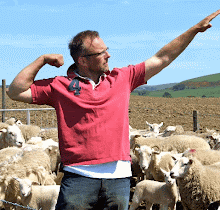
Warning: The following post contains constant and detailed reference to sheep and should not be read by those with a low tolerance to sheep chat ....


Three days back and its all been a bit bonkers here. The reality is that I owe people money, which I didn’t when I left for my trip. Six weeks of not doing consultancy and cash flow has stopped - one of the rules of first generation farming club I learnt whilst away was that Cash is King..... Bugger - I’m breaking the rules already.


In a vain attempt to stop the men with baseball bats coming to make enquiries, I sent 40 lambs too market on Thursday. The results made me think:


To make a fair comparison, lets use the price per kg figure and then make both the first two groups 40 kg lambs instead. Per head, the Wiltshire crosses would have been £63.60; the Texel crosses would have been £68.40 - that’s almost £5 of a difference. On this basis, taking an example of a total of 650 lambs sold, that would be £3,120 more income if they were all texel lambs. To make this difference up I’d need 699 Wilt cross lambs to produce the same income as just 650 texel crosses.


On the evidence of the above, I probably should be happy to drop the Wiltshire and just use Texel rams ..... but I can’t. See, once upon a time, I had this plan to breed my own peculiar composite ewe. It would shed its wool (that’s why I needed the Wiltshire), be prolific, a great mum and have good conformation. One day I would have thousands of these perfect sheep. I believe in fairy tales - I’m a dreamer and a romantic - but it’s the hope this plan might actually work in reality that makes me happy.


The lambs in the first group were either 62.5% or 56.25% Wilt (its less complex than it sounds, honest!) but only 12.5% or 7.25% Texel (Ok not doing myself any favours re the complexity argument, am I?). The end aim for the composite sheep is for them to be Wilt 50%, Texel 25% and Lleyn 25% with most of them producing Texel sired lambs. I’ll get good prices with patience. I just need to endure some pain before I experience the pleasure. It will all end happily ever after - honest!


Wednesday, 28 July 2010

IF.....

Dear Lord, thank you for the blessing you have bestowed upon me on this Nuffield trip. For the people I have met and for the words they have spoken. For the lessons they have taught me and for the sights I have seen. Most of all thank you for not allowing me to make a fool of myself too much by ensuring there was no easy access to karaoke and reminding me to do my flies up at every turn.


Now is the important bit: the translation from Nuffield bubble to reality. Please don’t let my uselessness hamper my ability to apply things that I can translate for good; and please don’t let my uselessness make me think things that will never work are a good idea.


That’s the thing - some things I have learnt could help me immensely if I can translate them properly; other things may seem a good idea but will never work in my situation or at the very best distract me from what should be my true focus.


To paraphrase Kipling (NB Rudyard not Mr Cakeman): If I can trust myself, when all men doubt me, but make allowances for their doubting too... If I can dream - and not make dreams my master; If I can think - and not make thoughts my aim..... If I can watch the things I gave my life to, broken, and stoop and build them up with worn out tools; .....If I can force my heart and nerve and sinew to serve my turn long after they are gone and so hold on when there is nothing in me except the will which says to them: “Hold on”.... Mine is the earth and everything that’s in it and maybe I might be close to being half a man. I realise I’m breaching the melodramatic restrictions that I should strictly apply to this blog but lets just forget this last paragraph ever happened.


I think we all have a "useless" side to our characters, something that distracts us from getting close to our full potential. But we all have really good traits too. The trip has made me realise more than anything that I really need to get my act together. A leopard can’t change his spots but he can add definition, body, gloss and have less split ends by using a different type of hair product. I’ll see if my spots can be made better by the product of this trip. Is there an analogy doctor in the house .... it’s an emergency!


Monday, 26 July 2010

Without Struggle, There is No Progress ....

The title of this post is taken from a Ms Dynamite lyric (I am so down with the kids, its well bad, innit?). Taking the huge leap from her application of the line as representative of social and racial suppression and the communal struggle against this; Mr Blanche is using it for the progress of first generation farmers.


I have heard of many stories of struggle on the path of progress to a successful farm business. One man came from a difficult background, he had witnessed his mother trying to drown his father in the bath amongst other horrendous alcohol induced violence. He left school at 15 without being able to read or write. But he now sees these as the basis of his determination, and as such - an absolute positive. At one point he lasted 8 months on bread and cheese alone because he didn’t have enough money for anything else. He remembers at the end of this period he sat down for lunch with his work mate and started crying - his lunch didn’t consist of bread and cheese, he finally could afford something better.


Another guy would sleep for 10 months in a year in his swag as he mustered to save up enough cash to build his business. He too was challenged on the diet front due to lack of money on more than one occassion - eating nothing but fruit cake for a fortnight once. He started his first mustering business at the age of 17 and within 2 weeks he was bust due to non-payment for his first two jobs.


In the height of drought another would get up at 4 am, cut bush (so her stock could eat it) till 8.30, school her kids till 3pm then go out again to cut more bush to keep her animals alive.


A man now with equity of over 15 million had, on the way, had his equity halved twice. The key is he kept going. He didn’t give up. As the Brumbie runner says - giving up is easy, anyone can give up. Not giving up is the defining characteristic of the men and women I have met and who have made it.


To quote a less fashionable musician, Billy Ocean - “When the going gets tough, the tough get going”. All street credibility safely destroyed ... phew!


Memoirs of the Unworthy ....

And so the end is near .....


I’m in Auckland and tomorrow I start the journey from end point back to the beginning. From Auckland to Methven in Perthshire is likely to take almost 40 hours but I suspect my thoughts will be delayed for much longer.


If I cast my mind back over the last six weeks the main things I take from it are that firstly there are other ways of doing things. There is a wider world out there both physically and in attitude. Much of what I’ve seen has made me question the barriers I, and no one else, have put in front of myself. I appreciate this is a cliche but sometimes cliches are true albeit unoriginal.


Secondly, has been the personal stories of first generation farmers. Without exception they have been exceptional people - special not in needs but in wants. Their determination, their ambition, their resilience make the ones that have made it in farming - without help, capital or gift - the best stories in agriculture. Assessment should be made of farmers not simply on the basis of where they are but where they are minus where they started. Judgement of individuals should be made not on what they are but who they are and the depth of their character. Those that have made it had depth, they had depth because all of them have dug deeper than most.


It was an honour to meet them all. I was probably an unworthy ambassador .... there is plenty digging ahead of me.

Sunday, 25 July 2010

The Yoda of the Ryegrass Plant ....

Mandi McLeod - a 2009 NZ Nuffield Scholar - was highly recommended to me as someone to visit. Her report on succession was excellent with some brilliant sound bites and she hasn’t failed to disappoint having met her. She lives just south of Hamilton with her partner Ant “Beetle” Beet, a 50:50 share milker.


Though Mandi came highly recommended, no one warned me about Beetle. He is a first generation farmer, who I suspect is in the top 5% of operators. Whereas some that I have met have been lucky with the timing of markets, Beetle has been hit twice by their vagaries and volatilities. 50:50 share milking is a three year deal, their capital is in the cows and cows have had a value of between $3,000 and $350 in the last 10 years. The share milker getting out after 3 years when cow price is flying is a wealthy man; Beetle got hit when no one wanted cows and almost had to start again. This is the very thing that makes his story better - he got hit then he started again, he got hit again but he still kept going and is now in a position to buy his own farm.


There are a lot of whistful words spoken in the UK on New Zealand farming methods, there is also some cynicism. What I would say is their breeding is good but so is ours in many ways, their scale is impressive but so is others, their low input for low loss at lambing is definitely something I am extremely envious of. But there is one thing they are head and shoulders above everyone else in - growing grass.


Going round his 2.5 hectare paddocks with Beetle opened a door to another room in farming. Things I had read about and heard about, I was eventually seeing ..... and finally believing. The ryegrass plant was talked about with deference and with a detailed understanding. Its physiology: once grazed it will grow again in 3 days, if immediately grazed again it has to drain itself of the strength to grow to its full potential; the senescence timing, moisture content and energy values it produces at different times of year; its response ratio to nitrogen at different soil temperatures; and most importantly of all the measurement of what’s there, the prediction of what will be there and how to fit this with the stock demand. It was a science and a logistical feat of management. It was serious. The same acre in North Island can grow 18 tonnes of grass dry matter or 9 tonnes - depending on how it is managed. The maintenance requirement for a dry dairy cow requires half its requirement as a newly calved animal. Twice and half - these are significant signposts on the grassy track to true efficiency.


If Beetle was the Yoda of Ryegrass, I’m hoping the Force is strong enough within me to use this amazing plant as a true Jedi Knight should use his light sabre - to defeat the dark side (my own desperate inefficiency). Yes, I know - too much TV as a child!

Its not what you do, its the way that you do it .....

What a difference an hour makes! Sometimes the shortest meetings are the best. I had from 11am to Midday to order a Hot Chocolate and the biggest Latte I’ve had in my life (it came it a bowl which meant my nose had a constant blob of white froth for a significant, embarrassing period!) plus interview my third NZ first generation sheep farmer as our paths briefly met on the shores of Lake Taupo in the North Island.


Alastair has a full time job but has entered sheep farming through leasing the land and stock on an 8,000 stock unit station hundreds of miles away from his home. He feels he has a business model that can yield 100% return on his capital and 7% from all farm assets (average sheep farmers may be struggling to get near 3% here). All he has to find is the working capital for inputs, wages and the rent for the land and stock (around $120,000)


In the absence of a clearly defined vehicle for progression - akin to share milking in dairying - Alastair has built his own in the sheep industry. He has accepted that most current farmers have increased their equity though their “land owning” - rather than their “farming” - business. In other words, most of the equity has been gained from the increase in land price rather than production profits. This is a really important point - I feel currently the only feasible option in the UK for those with minimum capital is to farm your way to a sustainable business. Buying land at current prices, well in excess of its productive value looks crazy ... and my bank manager would agree wholeheartedly.


He repeated Ben Allomes assertion - you have to be in the top 5% of operators to make a successful business from production alone. He called it “Operational Excellence”. You have to think outside the box and innovate. How does he achieve operational excellence? Simple systems was the top of the list - he only has two stock classes: sheep and cattle. With ewe hoggets, different breeds with different breeding strategies, all types of cattle youngstock; some equivalent farms might have 30 stock classes. The right genetics. Feed your sheep correctly - that meant rotational grazing of 1200 ewe mobs in 6-7Ha paddocks on the basis of detailed feed budgeting (a huge amount more dry matter can be grown this way). Forward planning. Excellent staff. In truth he felt it was 100 small things in addition to these but that was my hour up and I would have to wait to find out all the answers to Operational Excellence.


I waved goodbye with one hand whilst wiping the latte froth from my nose with the other.

Good things come to those who wait.....

At last ... I have touched a sheep! After a long five weeks without physical work I spent at least 10 minutes helping push sheep up a race for crutching ... phew, I need another 5 week rest now. They were Romneys and I have to say I liked them (Oh Lord, King of the Wool Shedding Sheep please forgive me).


I was there to meet Ben Allomes, former Share Milker of the Year and past President of Young Farmers. What a guy! His attitude was so positive, his clarity of thought exceptional. He and his wife Nikki started straight from University with no money. One of the first things they did was write down goals and a strategic plan. The main target was $1 million of equity in 10 years ... they did it in 7! He embraced debt and got excited by it. He was adamant that the only way to progress from a standing start was to be in the top 5% of operators. He drew me a graph of how equity grows and the process he went through. The shape of the graph was one I’d seen a number of times before from first generation farmers:


OK this just shows how crap I am with computers but its years are on the x axis; $ on the y!. They could be any values, I've just chosen 10 years and a million dollars - work with me here. Ben argues that this is typical of building a business from a low capital base. Some people give up in the middle of the graph thinking they are getting nowhere. He also had a view that the progression is made up of three crucial stages. The first third is gaining, perfecting and implementing skills. The second third is making contacts and proving to these contacts you were worthy of progression (hence opportunities arise). The final third was profiting financially from the previous 66.66 (recurring)%.


Second Rule of First Generation Farming Club - Be Persistent!