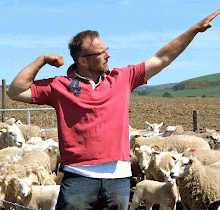
Mandi McLeod - a 2009 NZ Nuffield Scholar - was highly recommended to me as someone to visit. Her report on succession was excellent with some brilliant sound bites and she hasn’t failed to disappoint having met her. She lives just south of Hamilton with her partner Ant “Beetle” Beet, a 50:50 share milker.
Though Mandi came highly recommended, no one warned me about Beetle. He is a first generation farmer, who I suspect is in the top 5% of operators. Whereas some that I have met have been lucky with the timing of markets, Beetle has been hit twice by their vagaries and volatilities. 50:50 share milking is a three year deal, their capital is in the cows and cows have had a value of between $3,000 and $350 in the last 10 years. The share milker getting out after 3 years when cow price is flying is a wealthy man; Beetle got hit when no one wanted cows and almost had to start again. This is the very thing that makes his story better - he got hit then he started again, he got hit again but he still kept going and is now in a position to buy his own farm.
There are a lot of whistful words spoken in the UK on New Zealand farming methods, there is also some cynicism. What I would say is their breeding is good but so is ours in many ways, their scale is impressive but so is others, their low input for low loss at lambing is definitely something I am extremely envious of. But there is one thing they are head and shoulders above everyone else in - growing grass.
Going round his 2.5 hectare paddocks with Beetle opened a door to another room in farming. Things I had read about and heard about, I was eventually seeing ..... and finally believing. The ryegrass plant was talked about with deference and with a detailed understanding. Its physiology: once grazed it will grow again in 3 days, if immediately grazed again it has to drain itself of the strength to grow to its full potential; the senescence timing, moisture content and energy values it produces at different times of year; its response ratio to nitrogen at different soil temperatures; and most importantly of all the measurement of what’s there, the prediction of what will be there and how to fit this with the stock demand. It was a science and a logistical feat of management. It was serious. The same acre in North Island can grow 18 tonnes of grass dry matter or 9 tonnes - depending on how it is managed. The maintenance requirement for a dry dairy cow requires half its requirement as a newly calved animal. Twice and half - these are significant signposts on the grassy track to true efficiency.
If Beetle was the Yoda of Ryegrass, I’m hoping the Force is strong enough within me to use this amazing plant as a true Jedi Knight should use his light sabre - to defeat the dark side (my own desperate inefficiency). Yes, I know - too much TV as a child!