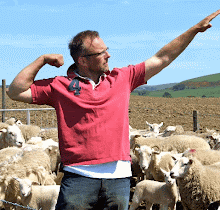
A huge proportion of my followers (50% of all two of them) have requested more detail on the sheep that I’ve come across here. Always keen to respond quickly to feedback, I have waited a week and finally got round to this - this ones for you Timothy....
Damarra and Dorper - wool shedders. The Damarra is a fat tailed sheep that isn’t too popular with processors as a pure bred. It is smaller than the dorper, hardy and has the ability for polyoestrus (Sp?) lambing (ie twice a year) I hope I’ve attached a photo of some cross Damarras; the Dorper - I saw mostly white faced - is a big sheep with a good carcass. A cross of the two is common with Garry Hannigan really pleased with a Dorper (50%); Damarra (25%) and Wiltshire Horn (25%) cross. Amazingly for all you Wilt breeders out there (Ok lets be honest that just means Tim...) the Wiltshire was added to increase prolificacy!!!! He was also using Meatmasters which from a hazy memory were cross Dorper/Damarras.
Though the Merino still rules in the pastoral country of the Outback there is a big shift toward the wool shedders. A Merino can add $15-20 of wool and $7-14 for its skin but its labour demands, huge risk of flies and poorer meat product make shedders a more attractive option in rangeland Australia due to the logistics and costs of mustering. This step change in production was symbolised by the Browns at Reola station home to one of the biggest and efficient wool sheds in Australia. It has the capability to allow shearing of 2,800 ewes a day. The Browns have since gone 90% toward wool shedders and the wool shed lies quiet for most of the year.
The Australian sheep flock has reduced from 180 million ewes to under 80 million and as a result their lamb price is probably better than ours ($120 for decent 50kg lambs). But down in South Australia pure Merino and first cross Merino ewes (with Border Leicester, White Suffolk or Poll Dorset) are almost the only way to go. Easier managed country and the financial importance of wool and Merino type skins make it the logical choice.
Graham Clothier at Lucindale taught me alot in terms of focusing on the essentials and keeping systems simple. Feed according to need, ensure good shelter to limit post lambing mortality and get as many lambs out of them as possible. This seems obvious but Graham was doing things beyond what I had actually considered. He also took me to Naracoorte market which was a bit different to UA Stirling! (see left)
I did go and see the the Breed president of the Wiltipolls near Strathalbyn. Wiltipolls are Wiltshire Horns crossed with a polled breed followed by four back crosses, with only the hornless selected (see below left). If you thought it was impossible to improve on a Wiltshire Horn, this is it and the yellow van will be coming to get you very soon using the Mental Health Act as an enforcement tool.
On my last visit in South Australia, I met an interesting man (Lynton Arney) who bred Border Leicesters - like our Border Leicesters but they looked far less like rabbits exposed to unhealthy levels of radiation. His branding was really impressive (sweatshirts, caps and even cooking aprons) and his method of client care - genuine but not intrusive; factual rather than hype - seemed really effective.
I am sorry for my poor photo placement and quality but I cannot accept liability for any dissatisfaction on anyones part especially those that play the banjo and are from Wiltshire.