Wednesday, 30 March 2011

Like a Virgin ...


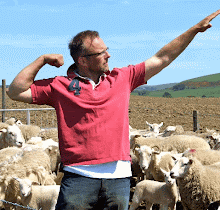
“My name’s Michael, thanks for coming .... you know you guys will always be special to me [cue slight unease in small group of complete strangers, straight off a mini bus from Aberdeenshire] .... I was a farm visit virgin ... and I’ve lost my virginity to you ... [cue unintentional but creepy smile from Michael].”

Some things sound a lot better in your head before departing from your brain, stopping briefly at your vocal cords then finding their final destination in a vast lonely expanse of open air and in the tangible discomfort of fellow human beings.
It was the first time I had a group come and see the sheep though.  I spent most of the time saying they weren't very good, even though I think they are.  I talked for over an hour about the sheep, how I started, what I do, what I feel and about the people I met during my Nuffield trips.  The Nuffield part of it might have been forty minutes of blether but it had to summarise eight and a half weeks of travel.  It focuses your mind on what the main issues have been.  Obviously, I admitted in front of grown men (and women) that I almost cried speaking to other grown men (and women) about Cambodia.  I then proceeded to get a bit emotional about it all over again.  That country gets me going every time.
No one fell asleep this time. Largely because they all had to stand ... in the cold ... 
Notes to Self: 
  1. Pursue mild forms of enforced discomfort on any future audiences to prevent them snoring
  2. Man up re. Cambodia, for goodness sake!!

Tuesday, 22 March 2011

The Free Radical ...

Last Monday lunchtime. Hendersons Salad Bar, Hanover Street, Edinburgh.
I am here to meet a real, live author ... one that writes books an’ that using actual words, some of which exceed my psychological barrier of 10 letters. 
I bought Andy Wightman’s book “Who Owns Scotland” in 1996, when I was still a Land Agent.  It pointed out an injustice of so much of this country being owned by so few of its inhabitants.  As a Land Agent, I acted mainly for land owners and companies with amazing powers of compulsory purchase.  Most of my clients were lovely, good people but there was always a feeling that I was playing for the wrong side.  I worked hard in training, at the end of the day I gave it 110%, without a shadow of a doubt ... but I took their money to help them make more of what they already had ... and there was always a slight guilt to it.  

Andy Wightman - author who knows some big words

Andy seems far more principled.  Injustice seems his defining motivation.  He has been described as Scotland’s leading Land Reform activist. There is a twinkle in his eye when he describes situations where he has publicly pointed out an inequity and an unfairness.  He seems to do this with a clarity that reveals something obviously unjust to those blinded by either the complexity and confusion of the subject matter or burdened by vested interest and extreme passion for their own position.
Anyway, back to the Salad Bar.  Andy orders the biggest “croquet” I have ever seen ... in my mind the rules on croquets centre on the assumption that a proper one can’t be more than 5 cm long ... this one smashes this rule by at least two fold.  I have a big crepe ... (a joke I really enjoyed when I was 8 and still find amusing today).
I had bought Andy’s new book “The Poor had no Lawyers”. I had got to page 42 by Monday and - in a panic, not wanting to appear ignorant - also read half a chapter on subsidy. The book sits in the bathroom where I can read it during my “quiet times” ... I quickly realise I should have had more “quiet times” before I met him.
We talk about inheritance.  There should be a law that land is transfered equally to all children in a family, not just one. Land would then be in the hands of more people and the land monopoly we have would be broken. We talk about Land Value Tax.  This would introduce a basic fairness to taxation and eliminate the excessive values of land and homes - that sees loss-making dairy farms in the west of Scotland selling for over £1 million.  Why should all rural businesses pay business rates other than landowners?  Andy tells of a method of redistribution of land in the Netherlands where a group of owners who feel their land holding is becoming fragmented put their satellite units into a pot and swap them for somewhere nearer ... the fact this would not happen here, says a huge amount about the land culture we live in.
I enjoy our chat ... and my big crepe.  I notice Andy has a freedom in his opinions. He doesn’t mind challenging perceived “wisdom” on land issues and the aggressive negativity that sometimes comes with such a challenge.  Rather he seems to revel in it.  As we leave he talks of some gifted individuals ... who can’t express what they really feel because they are employed by companies with vested interests.  I realise I’m in a privileged position ... as my own boss, I have a certain freedom already ... even amongst the constant craving for cash, it is this overarching freedom that makes it worthwhile. 
Back at the house, I read more of the book.  It has some really interesting stuff in it.  The history of how land was effectively stolen, grabbed or taken.  How tenanted farms represented 69% of holdings in 1940 and 28% of holdings in 2008.  How 20% of the Single Farm Payment in Scotland is recieved by just 2.77% of farmers ... almost a third of the budget being given to just over 5%.  He quotes Winston Churchill and Adam Smith to support his case. 
It makes me think ... I seem to have been buffeted by divergent and very strong opinions all the way through this Nuffield study ... I bend with this wind, listen to everyone and see all the points of view.  Quite often it seems, I don’t have my own voice ... or maybe its having a fear to let it make a noise.  It would be easier if it were black and white ... if people were entirely wrong or entirely right.  Andy appears to use justice as a benchmark and fairness as a gauge ... that’s not a bad start on the long and winding road toward clarity. 

Sunday, 13 March 2011

Dying is Easy, Public Speaking is Hard ...


Despite what the most recent blog posts suggest, I’ve been back in the country for a month ... I’m just really slow at constructing sentences and thinking about words containing more than four letters.  My brain speed seems to be constantly in first in the low ratio gearbox (or whatever that smaller stick next to the bigger stick in my pickup is called).
Imagine then, my discomfort when I had to speak at a Scottish Enterprise Rural Networking Event in Ayr on Tuesday.  Talking out loud has never been a strength of mine.  Putting a lot of words together in the right order over a 30 minute period is hard ... and harder still when 24 people are looking at me with total bewilderment in their eyes and 1 is fast asleep.  Talking in public requires a fast and sharp brain ... no luck there then.
I got a few laughs but not nearly as many as I'd hoped ... I should have brought a snare drum and symbol to communicate what I just said was intended to be amusing.
Embarrassing highlights included: reading out lyrics from a Mylie Cyrus song (the bewilderment factor was raised at least three notches during that error of judgement) and almost crying when I talked about Cambodia ... voice quiver ... dramatic pause ... it was really close.  I talked about emotion a lot, and bared my soul a little ... to the point I expect most of the audience were uncomfortable and thinking I should really go and see Dr Bonkers (the famed Psycho-analyst).
That said there were some things I said that had potential.  It focused me.  Oddly I appreciated so much more of what I had learnt in India and Cambodia during the process of speaking in Ayr.  If I came back from those countries with one word it would be “Innovation” ... although this is neck and neck with “Perspective” and “Sorry”.
I still need a lot of practice in speaking out loud though .... a LOT of practice.

Friday, 4 March 2011

[in the style of the Batman theme] da na na na na na na na - Hat Man! ...


In my last post I briefly mentioned a chance meeting with an elderly man who wore a hat ... on a plane ... who sang songs in public.  I also mentioned that the Raipur leg was my nominal contribution to the organisation of the trip.  The first day went well ... largely because Ricky Thaper organised it ... not me.  
Day 2 proves more of a challenge.  There is nothing arranged. In desperation to please my restless colleagues, I phone Hat Man on Day 1.  He is in “a meeting” and says he’ll phone me back ... he doesn’t ... I berate myself for thinking he might.  Next day ... a lie in, a relaxed breakfast, we get to 11.30 and no one has complained directly about doing nothing but there is an undeniable air of frustration.  We try to take a rickshaw to a Walmart to see what an Indian supermarket looks like.  The non-English speaking rickshaw driver reckons I must have meant the centre of town and takes a punt, leaving us lost in a busy street ... nowhere near a Walmart.  
Just as all hope of not wandering around aimlessly is at an end ... Hat-Man phones.  He has been to our hotel with his brother - head of the agricultural department of Chattisgarh.  His brother has had to leave for a “meeting” but we head for his office. Raipur is a big city ... we are the only westerners ... as we start the goose chase, people stare, smile and wave.  We enjoy our adventure ... at least, I do.  I smile and wave and even do the “thumbs up” more than is technically cool, as we walk.  
After asking at least five times for directions we get to the office.  Hat Man is actually called Mr Poorit and he is high up in a renewable energy company (Tony likes renewables so he is pleased).  Mr Poorit is a character.  A former colonel in the Indian army, a veteran of three wars he possesses a personal wisdom that comes from a very full life.  I love old men like Mr Poorit. He is excentric, mischievous and warm ... what I want to be when I’m old. I feel we click and have an odd bromance for 20 whole minutes.

Tony, me and Mr Poorit ... in the final of the "Funniest Face" competition.
Above Tony's head there is a picture.  It says "... for everything you gain; you lose something else; it is about your outlook towards it; you can either regret ... or rejoice".  Deep! 

He tells us that Indians are misers, they are real business men and ... in a Borat type moment - they are “like the Jew”.  Britishers are nice but they are not financially as bright as Indians.  Mahatma Gandhi was a good guy but his policy of non-violence was wrong. If someone hits you, you hit them back harder.  I loved it ... not because I agreed with everything but just because his opinions were definite and devoid of malice (though I suppose hitting people isn't that nice).
We finish by singing a Doris Day song in the middle of a busy office... “Que Sera, Sera, ...Whatever will be, will be ... The future's not ours, to see ... Que Sera, Sera ...”  Given my midlife crisis and my palm reading that shows I have no life line from now on ... I consider this appropriate.  We shake hands, knowing we got on well, but knowing we will never see each other again.  I am emotional about our farewell, which I wasn’t expecting.  Goodbye Mr Poorit ... the honour was all mine.

Friday, 25 February 2011

Intensive Care ....


Delhi airport.  Its Thursday.
We have said goodbye to James. We cry longingly on each others shoulders and seek professional advice for our combined loss.  Obviously I am using sarcasm to cover up the fact that this is almost true.
After taking all the responsibility for so long as group leader, organiser and Michael Blanche’s chief carer, Tony gets a well earned rest.  He has been immense.  We had a tipsy chat in November. I said I was going to Cambodia and India. He said he’d like to come ... thereafter he organised almost everything.  If it wasn’t for him I think I’d still be at Phnom Penh airport trying to work out how the electronic doors worked.
This was the part of the trip I “organised”.  This basically involved asking Ricky Thaper (treasurer and spokesman for the Poultry Federation of India) to organise things for me.  We meet Ricky ... he laughs at my jokes ... what a great guy!! 
We fly to Raipur, capital of the state of Chattisgarh.  I sit next to an elderly man with a hat.  He sings a lot. I join in when I can.  He insists we contact him during our visit.  I am not sure if this is a terrorist trap.
The next day we visit the ABIS group.  Owned by Mr Bahadur Ali, the business had 10,000 broiler chickens in 1985.  Now it turns over 2.5 million birds per cycle and there are 7 cycles per year.  It has quarter of a million breeding birds.  He has a 2,500 dairy cow herd and 1,500 buffalo. He has a huge feed mill. He produces pet food, fish feed and 5,000 tonnes of solvent.  The milk is packed and sold under his own label.  30 veterinarians work in the business ... everyone we meet is called “doctor”. The business has a 2,500 labour force.
The Group with one of the many Doctors and Ricky in the foreground
I’d seen vertical integration before but this seemed to also include horizontal, backwards, forwards and sideways integration too.  You sensed there were no barriers in ambition or, indeed, implementation.  There was no fear in growing the business.  It was like going to visit the aftermath of a huge business explosion.
At the end of our day we meet the main man - Mr Bahadur Ali - he walks in and there is an aura about him.  He is more comfortable speaking his native tongue ... which adds to the mystery.  His questions are incisive and very focused.  Weirdly, his questions are kind of answers in themselves as they seem to reveal what the important issues are on a particular subject.
He explains how he took his business from a humble beginning to one of the biggest agri-businesses in India.  From 1985 to 1996 he built the business’s effectiveness.  But growth was relatively slow. 1996 saw him attend the International Poultry Congress and that event seems to have transformed his whole business. His vision was radicalised ... to drive for scale and vertical integration.  Thereafter, the growth graph was close to being as vertical as his integration.  It rang a bell ... this was the graph a share milker in New Zealand drew me on the back of an envelope ... it was the graph a Kiwi equity partner now worth millions of dollars showed me on his computer ... the graph of an effective first generation business.  Frustratingly slow growth then .... ker-bam (if that is a word) ... a steep line upwards thereafter.
The ABIS group operate - as far as I could work out - on just over 100 acres.  I’ve seen intensive agricultural businesses before but this was another level.  I know its not quite a true benchmark figure - they rely on other farmers for a lot of raw material and some of the enterprises are beyond agriculture - but the business’s Output ... my calculator tells me ... is over £1.5 million per acre!

The wonder of labour - everytime a calf defecated there was someone on hand to clear it up
Mr Ali asks us about the potential for a serious sheep business in India.  I suddenly get a dose of verbal Delhi belly ... my words come straight from my head through my mouth without touching the sides.  I thought it would be a great idea ... introduce better genetics ... get hold of lots of land ... rely on scale ... on and on I went ... it was becoming interminable.  Mr Bahadar Ali asked what stocking rates we had in the UK for sheep.  4 ewes to the acre on decent permanent pasture, up to 7 on good stuff, I said ... I was unstoppable ... I thought he would be impressed.  The colleagues from ABIS looked at each other, paused and then laughed for a long time ... 4 ewes per acre versus £1.5 million turnover per acre.  
Being laughed at made me think.  Land in Chattisgarh would be worth around £30,000 per acre.  We don’t have values like that ... yet.  However, if the land price in the UK continues on its crazy path ... I’ll probably live to see the day they are.  We will still only have land that supports 4 ewes to the acre.  Maybe the Indians were right ... it is comical.  Intensification and integration are a lot more serious. They can feed the world. Taking this theory to its logical conclusion, maybe the sheep industry has no future on any land that can be used for any other conceivable purpose.  Its a cheap land enterprise and cheap land may never be again. Maybe the entire UK sheep industry will be forced to retreat to the hills ... spending the rest of its days with its begging bowl held high.

Saturday, 19 February 2011

Bright Colours, Broad Brush ....

Taxi rank, Udaipur Airport, Rajasthan, India.  Its Monday.
The established farmers want an air-con taxi ... the new entrants want to spend as little money as possible (especially the one (clue: not Rona) who has lost his wallet). We would prefer to spend £10 less and wind the windows down.  The group splits: 3 to worship the air-con god with me and Rona on the budget deal.  It slowly dawns on me that 1800 rupees divided by two is more than 2400 rupees divided by three .... bugger!  
I smell smells in the warm air that rushes through my open window.  Yet its the bright colours that have most impact.  These colours are man made and worn by man but feel intrinsic to this land.  Ladies with saris of vivid pinks, yellows and reds; men have turbans of equal brilliance.  
The “established ones” laugh at us as they pass in their decadence ... then take amused pleasure in pointing out the aforementioned arithmetic when we arrive at Ranakpur two hours later.  I go in a huff for a total of 3 whole minutes.
We are staying in tents ... but nice ones.  Tony loses the drawing straws contest and has to endure my snoring ... yet again.  We are met by Ilse (she is German) and Hanwant who run LPPS, an organisation that aims to preserve sheep pastoral and camel herding traditions and rights.  They take us immediately to a sheep shearing “festival”.  The shepherds are dressed up for the occasion.  They chat, laugh and smoke as they part the wool, slowly and deliberately, from their sheep. This is not about economics but about brotherhood.

Smokin' Mike Blanche .... it was just tabacco ... I think

I tell them that I have 600 sheep and achieve a 150% lambing ... it is the first time anyone has been impressed with this .... I should come here more often.  For a few moments I am the Shepherd God ... in my own mind.
The next morning we are taken to see camels and their herders.  Hanwant honours us by presenting us with turbans from his Rajput (warrior) caste.  He has not accounted for the fact I have a head so big, my neck could theoretically snap at any minute. It is so huge scientists have recognised that it possesses its own gravitational force and that tiny moons orbit round it. The Turban sits awkwardly well above my cranium’s full circumference. 

The Rajasthani Massive ... Kevin doesn't have height issues ... he's just kneeling down

Again the herders are far less about money and far more about life ... about relationships with their animal charges and with each other.  They give us camel milk, warmed as it would have been warmed a millennium ago.  They proudly stuff Neem leaves up a camel’s rectum and then clamp the aforementioned orifice with a split stick.  I wince as my imagination allows me to go through the logistics of how this procedure could be completed ... with me as the patient. 


The clamping procedure - do not try this at home!  Nice turban colours though. 
In the afternoon we have a deep debate then go to a temple - Kevin provides the sound track with a full discography from Walt Disney’s Jungle Book.  In the evening we visit Ilse and Hanwant for dinner.  We see the camel poo paper being made and hear about the camel milk ice cream. They are innovating in order to preserve - rather than change - a way of life. We have yet another deep debate ... I'm starting to enjoy them in a masachistic kind of way.  
In the morning I have time for one more huff before we leave ... I must be on my man period.  I travelled Australia and New Zealand on my own.  Here I have four strong and admirable characters with me.  I learn much from all of them. They make me question things.  Sometimes - in business terms - I feel far, far behind them.  I think I am burdened to be like my fellow Rajasthani shepherds ... less about economics, more about brotherhood.  I fear I will always be short of money as I give up any possibility of wealth as a sacrifice ... to my very own ... God of Dreams. 


Camel milk actually tasted pretty good. Light and frothy ... mmm!

Either I've grown, or this is a small camel.  The unfortunate head size to turban circumference ratio / matrix dilemma, can be seen clearly here. 


Thursday, 17 February 2011

Carry On Up the Punjab ....


Somewhere near Chandigarh, Punjab, India.  Its Saturday. The group now numbers five ... we’re not exactly famous but at least three of us have had lashings and lashings of ginger beer the night before.


We take a walk through Chandigarh centre to experience the shabby madness that seems to be standard in India’s urban centres. James gets his shoes polished.  I do too. James pays his polisher the equivalent of 20 times the normal rate .... everyone gets very excited ... a rather large and amused crowd has now gathered ... its all I can do to convince my man 7.5 times the correct rate is acceptable. I power walk ... hips wiggling vigourously ... away from the problem.

The initiation of the shoe shine incident ... before the crowd gathered

We are picked up by the sophisticated Kanwal.  Tony - our glorious leader - had found his farm stay on the internet. It turns out its like some sort of cyber gold rush ... the guy is brilliant.  We visit two dairy farms, inspect wheat and vegetables.  The Punjab is India’s Japati basket. 44% of the grains (rice and wheat) produced in India are produced here ... on 2 % of the country’s farm land.  Bare agricultural land values range from £30,000 to £60,000 per acre ... hope value (for future development) has a massive impact that drives up price even further.  The Green Belt around Chandigarh can command up to $500 million for 1 acre. 
Land in Punjab was subject to severe legislation after independance.  The maximum holding any individual could own was set at 25 acres. This together with subsequent splits via inheritance means farms are small (90% of farms in all of India are 5 acres or less) ... yet 3 crops of maize a year is easy in Punjab, one guy reckoned 4 was possible.  The first dairy farmer we meet tells how his grandfather dug a well in 1947 and only needed to go to 10 feet; his father then dug a well in 1962 and had to go deeper - 62 feet; then he himself had to dig a well in 2010 ... to get to water he had to bore to 500 feet.  Such is the challenge in the Punjab ... what the weather giveth, the weather (and extreme irrigation) now taketh away.  The significant move to dairy ... away from thirsty rice ... is a reaction to this challenge.
We meet the head of the village and all his family ... he has a big family.  We drink sugar lightly diluted with warm buffalo milk. We drink tap water.  We are an attraction. A child comes in and as if in awe of a deity,  swiftly kneels to touch Rona’s sandals then quickly departs.


The village leader and his family ... just after we'd drank tap water

We return to Kanwal’s house and meet his father.  He is a serene Sikh gentleman with a warm sense of humour.  We learn much just talking to the father and son team.  From their reading of my palm, I learn that I have had a midlife crisis and the future is not foretold ... I consider this does not represent new information. I then worry that there is no life after the mid life crisis thing and keep looking at my palm in case the line has formed yet.  They both get very excited by James’s hand, its so unusual I think they might wet themselves in some sort of synchronised urination display.  He is nicknamed golden hands for at least ten minutes.
We giggle on and off for another 24 hours ... we have deep debates ... we learn many new things about India and each other ... until on our last night we up the giggle intensity ... I giggle like I haven’t giggled for a long, long time.  My stomach hurts as I go to bed - its a happy hurt ... though it still could be the tap water.